he scenes in a Liverpool Marks & Spencer, after the release of the chain's chocolate and cornflake cookie earlier this month, looked like brink-of-Covid panic buying crossed with a zombie apocalypse. It probably didn't help that the baked goods hit the shelves at around the time the government started asking Britons to plan for an unnamed near-term disaster. How would we cope with a national emergency when we coped this badly with the crisis of not enough biscuits?
You could explain the M&S cookie fever with reference to the company's product development icon, Kathryn Turner, who has half a million followers between Instagram and TikTok, or the powerful urge to belong, in gen Z particularly. But it surely has something to do with the biscuit itself. As Rosie Sykes, the author of The Friday Biscuit, says: "Biscuits are very much part of the national fabric." But lately they've had this "slightly weird glow-up", gone "a bit max", Sykes says. Whatever the flavour, there is always chocolate in them, and always more of it than you'd credit. Even the packaging on the M&S cookies – clear, crinkly – has the main-event feel of a bouquet or a hamper. Except if you put these cookies in a box, that box would be ginormous, and people would say: "I can't eat five of those – don't be stupid."
Seraphi Bouchier Hayes, 23, works in marketing and speaks digital like, well, a native. "Everyone's always loved M&S for the summer – picnics and stuff; they have their own song – and for any journey, you'd get a premixed drink. People call it 'journey juice', but it would cringe me out to say that."
Their own song? She sings it for me: "It is the season of picky bits / If you can stick a toothpick in it / Then you can bring it to my pic-a-nic." I'm not convinced it's been signed off by M&S's product team.
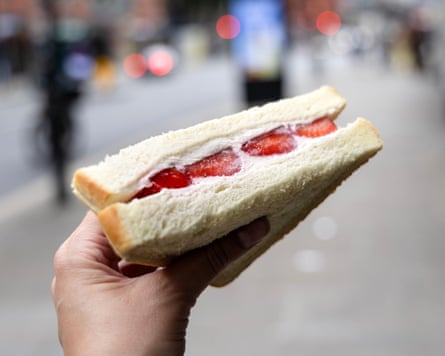
The TikTok crowd aren't in the store for meals. M&S is very good at picking up on a viral food trend and tailoring it. When Dubai chocolate was everywhere, it brought out a line of pistachio products. "The big thing two summers ago was the strawberries and cream sandwich during Wimbledon," says Bouchier Hayes. "It's a Japanese thing, but they made it into the tennis sandwich, and apparently it was quite nice."
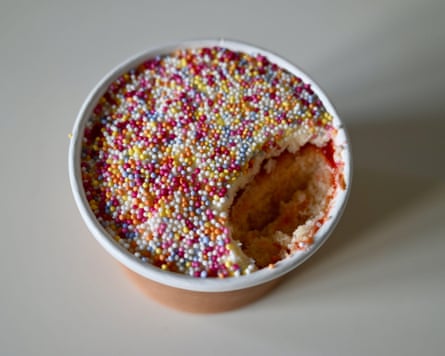
M&S also has a "dot cake", a sponge with tooth-achingly sweet buttercream icing that you eat out of a pot with a spoon. This is a homage to a New York bakery's cake that hit the sweet spot of unboxing (people filmed themselves cracking into the virgin, individuated pots), ASMR (they make a lot of cracking, squelching noises) and slightly outlandish expense (they were between $8 and $12 each, or about £6 to £9). Marks and Sparks's take was less garish, much cheaper (£1.10) and perfectly tasty. It became an instant TikTok pilgrimage item.
M&S stampede foods are often more about plugging in and "belongingness" than they are about originality. People make mini-careers on Instagram out of just going into the shop to try things, such as the double chocolate bloomer (a loaf of bread with added chocolate). These viral foods are often in-store only; you don't create an internet sensation with stuff you can buy on the internet, paradoxically but understandably.
This has something in common with the psychodynamics of the mukbang, a trend that originated in South Korea. The word is a portmanteau of "eating" () and "broadcast" (). Basically, some (usually beautiful) person will film themselves eating an awesome amount of food. And that's it. A 2020 review of the mukbang literature yielded some insights that were quite sad: for example, that people are lonely, and the mukbang makes them feel as though they're eating with others. But there's also an interesting, childlike, fantasy excess about it all. Ultimately, who stops you eating 17 eggs, or an entire tin of differently shaped tiny sweets, or bread with added chocolate? Your mum. It's like a portal to a childhood where everything's taken to the max, and the cold, dead hand of responsible adulthood does not exist – which is to say, paradise.
That makes sense of the Turner phenomenon: she is a 56-year-old mother of three, yet she would never tell you not to overdo it – the opposite. In her kitchen, it's liberty hall. She is wildly enthusiastic over every pretzel, but her enthusiasm is the only thing about her that's wild. She is every inch the kind authority figure, completely normal except for her snacks, and so alluring that gen Z influencers were dressing up as her for Halloween. "It wasn't hard," says Bouchier Hayes. "You just had to stand outside M&S wearing what she wears. And if no one got it, you'd say: 'I'm Kathryn Turner, the product developer for M&S.'"
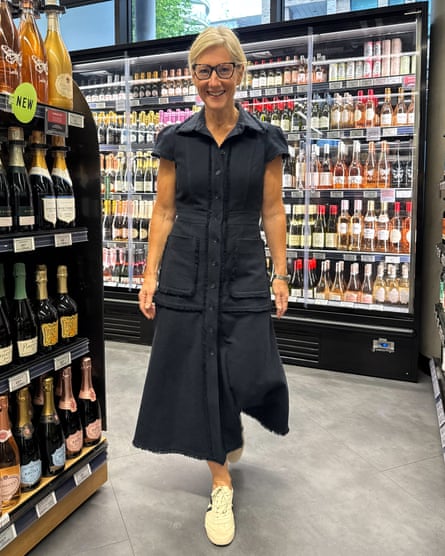
I know this isn't about me, but I contacted M&S to ask if Turner would speak to me, and when it refused, I was gobsmacked. We're both women of a similar age, I'm nice, she seems nice, all I want to do is ask how come she's so good at her job … It was honestly the maddest rejection I've ever had. But then I spoke to friends who work for the tabloids and it transpires I am the mad one: everyone has been asking to speak to her for 18 months, and the Sun and Vogue have given up and printed profiles with quotes they've pulled off Instagram. Again, without wishing to be either solipsistic or insider-y, this is absolutely unheard of. Aloof, private and always in control of her own image, Turner is the Kate Moss of supermarket product development. There has never been a Kate Moss of supermarket product development.
But Turner has worked at the retailer since the 1990s, and the commitment to zeitgeist did not start in the past few years, nor did it originate with her. M&S, which began as a market stall 142 years ago, was the first store to sell sandwiches in a skillet (the triangular pack with the film cover). This was 1980, and it started in scattered stores in Edinburgh, Leeds, Croydon and Cambridge. Staff were making them overnight, and they were so popular that the Cambridge staff started throwing pilchards in just to keep the production line going. "That enables a lunchtime food market," recalls Polly Russell, who was a product developer in the fish department in the late 90s, and is now an author, food historian and curator at the British Library. "This really transforms that move towards not eating in a canteen or cafe or bringing in a packed lunch."
Before that was M&S's most famous launch: the chicken kiev ready meal, in 1979. "That was classic French restaurant fare, but also the sort of thing that a housewife would like to serve up to her husband's boss," Russell summarises. "Dinner-party elegance and status, appealing to people who wanted to be comfortable in that register. Off the back of that, you get the development of the ready meal: it's a mixture of TV dinner convenience, but also luxury, things that you can't make yourself." That's an interesting through-line, from the kiev to the cookie – things that are actually quite hard to make at home. "Biscuits are harder than cakes," Sykes says. "I've been a cook for 35 years, and I know that you can make a biscuit recipe many times, and it won't necessarily turn out the same. There are a lot of variables. If the weather's hotter and the flour's drier … with a cake, that's not so much the case."
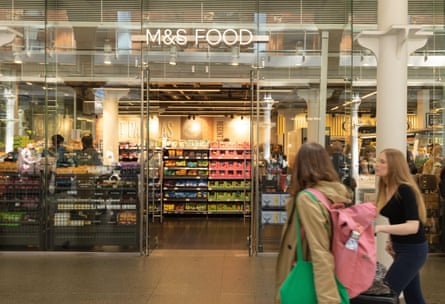
Russell's heyday was when they reinvented sushi. Yo! Sushi was on manoeuvres with real sushi and fancy conveyor belts in 1997, but M&S was the first supermarket to launch prepacked sushi. "They didn't go into the market with raw fish, because at that time sushi was weird," Russell says. "They could see it was going to be big, so they went in with fish people already understood: smoked mackerel, smoked salmon, prawns. It was a version that was delicious but it was still British. It was massive when it launched. It was the new sandwich." If you remember that era, you'll also remember the salmon pinwheel. Unbelievably tasty.
Soon the other supermarkets had caught up, as they always do. But if you want to know why M&S was first, it's the same reason US drama used to seem so flawless, so failsafe, while we were constantly surprised by random flashes of British genius such as Fawlty Towers or The Office: the sheer size of the writers' room, or in M&S's case, the product development room. It was bursting at the seams with developers – a score of people just on fish.
"In the development kitchen, you were working really closely with suppliers, with other product developers, a buyer and a technologist," Russell says. "They really did invest in supporting product developers' research, talking to chefs, trying to work out what was happening outside the mainstream, as well as trying to understand the technological innovation that could take these things mass-market."
She remembers her job interview, when they asked: "Can you give an example of when you've done something really innovative in order to save money and you were pleased with the result?" Her example wasn't even about food – she'd had to go to a fancy wedding, skint, and she'd bought a huge straw hat plus some feathers from John Lewis. "I looked posh for 12 quid. They loved that."
M&S freely accepts, even boasts, that it created the term "picky bits", a phrase that doesn't even feel class-coded since everyone hates it. But it has historically been the pioneer of everything, from packed lunches to husband's boss dinner parties, through party food, deli Christmas, romantic main meal, side and wine deals, picnics. It has always been remarkably successful at capturing a food trend or just a mood, and making it edible. "They understand a social and cultural moment," Russell says, "about feeling special, treating yourself – but what that looks like is always slightly different. Now, with food, there's less of a fixation on being smart or impressing people; it's about pleasure and fun and conviviality. It's almost as though you're in a gang of co-conspirators to have the best fun you can. And what you're being offered through that cookie range is the most joyful, exuberant, over-the-top ingredient."
It's generation-specific – gen Z and younger millennials – because it's about a precise relationship with social media: in part, surely, a rejection of the wellness scene, all giant water bottles and two yoga mats, which is getting a bit tired. But also, a passion for physically somewhere, tasting something, being in the world. AI might take your job, but it cannot mimic or ever understand your delight in a cookie.
Honestly, the only food I go into M&S for is the combo mix potato snacks and "they're not viral", says Bouchier Hayes. "I feel like I would have them at a service station." Doesn't matter – M&S know where the viral is. It knows it's not gen X, and it makes crisps for us anyway. Which, sincerely, we all appreciate; we're just not about to make up a song about it.