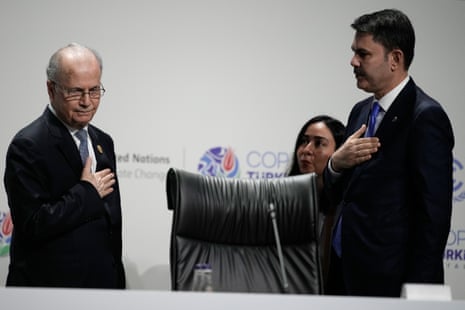
World leaders will hold sway over Cop again today, as they swing through a series of bilateral meetings and roundtables on subjects from methane to forest finance. Prime minister Andy Burnham of the UK has arrived, and is set to follow up Ed Miliband's warnings on the climate threat to national security with the appointment of a first climate security adviser. He will grab a bilateral with President Lula of Brazil while in town, before departing – with most other European leaders – to the Dublin conference on AI.
But while the leaders carry on their photo opportunities, and their entourages clog up the central halls with thickets of security guards, in the background negotiators are quietly working their way through the reams of text that are the main output of the annual "conference of the parties".
The agenda for Cop31 was agreed without much delay on Monday, but one item on which there was no agreement was the status of any "cover decision" from this year's meeting.
Most Cops produce a cover decision, which is a handy way of gathering together some of the disparate threads of discussion that take place across these halls. Few Cop presidents try to get by without one – at Cop29, in Azerbaijan in 2024, the presidential decision to do without angered many parties.
The cover decision has formal status within Cops – it is negotiated, and gavelled through at the end, so the resolutions it contains are binding and countries can be held to them later. But unlike the other formal negotiating streams, which focus clearly on a single topic, the cover decision is a mixed bag, containing a variety of elements that can range from the decorative, such as thanks to parties and organisations the negotiators wish to acknowledge, or nods to issues such as gender equality and inclusion, and recognition of important issues that do not have a home elsewhere in the negotiations, such as the health impacts of the climate crisis, or concerns about the state of the oceans.
But the cover decision can also be where key elements of progress are made. It was a cover decision at Cop26 in Glasgow in 2021 that yielded the resolution to "phase down" coal; and one at Cop28 in Dubai in 2023 where the key pledge to "transition away from fossil fuels" was nestled among reams of other text.
This year, Australia has left open the option of having a cover decision, but some key groups appear opposed, including the Arab Group, Russia and the Like-Minded Developing Countries, a grouping usually heavily influenced by Saudi Arabia, with India and sometimes China as members.
The items that could be in a cover decision this year include the pledge to derive 35% of final energy from electricity by 2035; recognition of the Brazilian roadmap to "transition away from fossil fuels"; the overshoot of the 1.5C temperature rise limit; the work of the Intergovernmental Panel on Climate Change; and adaptation finance for poor countries.
That brings us to the end of the leaders' speeches. Some themes seemed to repeat. Time and again over the last two days, leaders from poor, low-emitting countries urged rich polluters to stump up more cash. Small island states pleaded for emissions cuts that would limit how much global heating overshoots the 1.5C target. Rich countries (those that showed, at least) were enthusiastic about electrification. Only a few of them, though, were also willing to call out fossil fuels.
Now the heads of state have come and gone, more of the attention at Cop31 will go to the negotiations happening behind closed doors.
Ruslan Edelgeriyev, special representative of the president of the Russian Federation on climate issues, said the future is in "natural gas and viable new technologies".
He added that "while politicians argue, actual problems" are being solved by clean energy businesses in Russia, and that "states should preserve the sovereign right" to choose their "optimal energy balance".
No standing ovation there.
Hello, it's Ajit Niranjan here again, taking back the blog from my colleague Matthew Pearce.
We've just heard from Kang Kum-Sil, South Korea's climate ambassador, who has spoken about some of what her country – a major coal consumer – is doing to electrify. She's also echoing what many leaders have said about geopolitical crises. "Cop31 must demonstrate that multilateral cooperation remains an effective means of addressing climate change."
Every day during Cop31 we are hearing from people affected by the climate crisis. Earlier this week, we published a powerful testimony from Darcy Ruddy, the owner-operator of an excavation company in western Canada.
Just before a wildfire swept through parts of his home town, Jasper, he was finishing work at a nearby luxury heliskiing lodge. Climate change made the higher temperatures the week before the fire and the day it ignited more likely. This is his story:
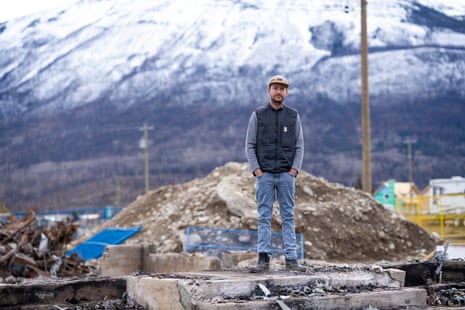
I'd landed this big job at a heliskiing lodge in Valemount. I finished 95% and was excited because I was going on this mountain biking trip in the Chilcotins [mountain range]. I was like: "I'm just going to leave the machines here. I'll go home tonight, grab my camper van, and I'll move them when I get back." Had I not done that, I would have lost everything.
As I was driving back into town, there was this intense warm air. It was nice out, but it was stormy. I made a joke that morning: "Big lightning come to town tonight? About time Jasper burns." Didn't expect it to happen but, as I drove into town, I looked at my gas gauge and I was like: "I better go fill this thing up."
At home, I pulled my van into the back. I was looking at the sky and enjoying a leftover gin and tonic. I was like: "Something doesn't feel right." My buddy Alex messaged me: "There was a lightning strike out here. I see open flame." I turned on my radio and my buddy, who works for parks, was evacuating a campground. I could hear the intensity in his voice. Holy fuck, this is it.
I called my dad. He was out for dinner with a friend. I was like: "Dad, pay for dinner, get the hell out of there. We got to start packing."
Nthomeng Majara, deputy prime minister of Lesotho, reminded world leaders that small countries like hers suffer the worst impacts of climate change, "despite contributing negligibly to greenhouse gas emissions".
She said that people of Lesotho are facing adverse effects of changing rainfall patterns, recurrent droughts, floods, land degradation and other climate risks, which affected food production and security.
"Countries that have contributed least to the problem should not bear a disproportionate burden of its consequences, she said. "Global climate action must be guided by equity and respective capabilities.
Fatafehi Fakafanua, prime minister of Tonga, said the developed world must "finally meet its moral and legal duties" to reduce emissions and help smaller economies reduce theirs.
"At forums like this, we've been told that we ask too much – that our red lines are unreasonable," he said. "We all have a part to play. For when these meetings end, each of us, must live with our conscience. What we know to do, we cannot leave it undone.
"Antalya must be the turning point where the developed world finally meets its moral and legal duties."
Matthew Wale, prime minister of Solomon Islands, said his country is in "perpetual climate disaster recovery mode" because of climate breakdown.
"As I speak, my people face a protracted El Niño, while recovering from a category 5 cyclone. We remain in a perpetual climate disaster recovery mode.
"There must be some moral thinking on this. The Cop31 climate action agenda targets must result in tangible outcomes."
He called on leaders to start publishing "pledge disbursement timelines" to spotlight whether climate finance is making its way to small economies, and independent tracking on delivery.
The prime minister of Lebanon, Nawaf Salam, said climate rehabilitation must be woven into rehabilitating the country from Israel's war on Lebanon.
"The environmental scars of war will affect ecosystems, livelihoods of communities for years to come," he said. "Recovery therefore must go beyond rebuilding homes and rebuilding homes and roads. It must restore agricultural roads, rehabilitate ecosystems and revive livelihoods."
"Lebabnon insists that environmental restoration and climate resistance be integral to the reconstruction, alongside stability, the restoration of our sovereignty, and respect for international law."
"Showing up is not enough". That's the message that civil society organisations have for Andy Burnham. The UK prime minister spoke at Cop31 earlier, underlining that Britain was "ready to play its full part" in tackling the climate crisis.
While broadly welcoming his making the effort to actually go to the summit, green groups have been sceptical about his intervention. Beth John, Oxfam GB's climate justice adviser, said Burnham's appearance "sends a positive signal".
But, she added: "Showing up is not enough: a crisis of this scale needs substantive action, not just signals. The real test of climate leadership is delivery, not declarations."
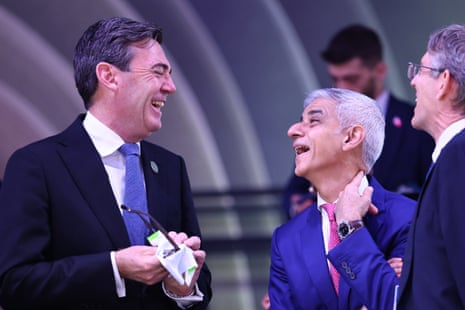
Burnham indicated his support for Turkey's called for increased electrification, which has been a major target of Cop31. But without nuance, that target risks embedding global inequalities, pointed out Leon Sealey-Huggins, senior climate justice campaigner at War On Want.
"The Cop's 35% electrification target is based on extending current global energy inequalities," Sealey-Huggins said. "According to various scenarios used in the IEA's analyses that inform its targets, the US is projected to consume five times more energy per capita than in South Asia, and 17 times Africa's per capita energy consumption.
"Worse, the electrification pledge can only be realised if climate finance is provided to those countries that need it, including those 730 million people who still lack access to electricity."
Mohammed Mustafa, prime minister of Palestine, received a standing ovation to his speech. He said despite the Israel's destruction of Gaza, Palestine remains committed to reaching its climate targets. He went on to implore world leaders to do more to help the people of his country.
"Our message from Palestine is clear: no people should be deprived of the right declined of the right [to climate justice] because of occupation," he said. "We still need your support."