
A decision by two councils to publish details about houses of multiple occupation (HMOs) online could increase danger to migrants, a campaigner has said.
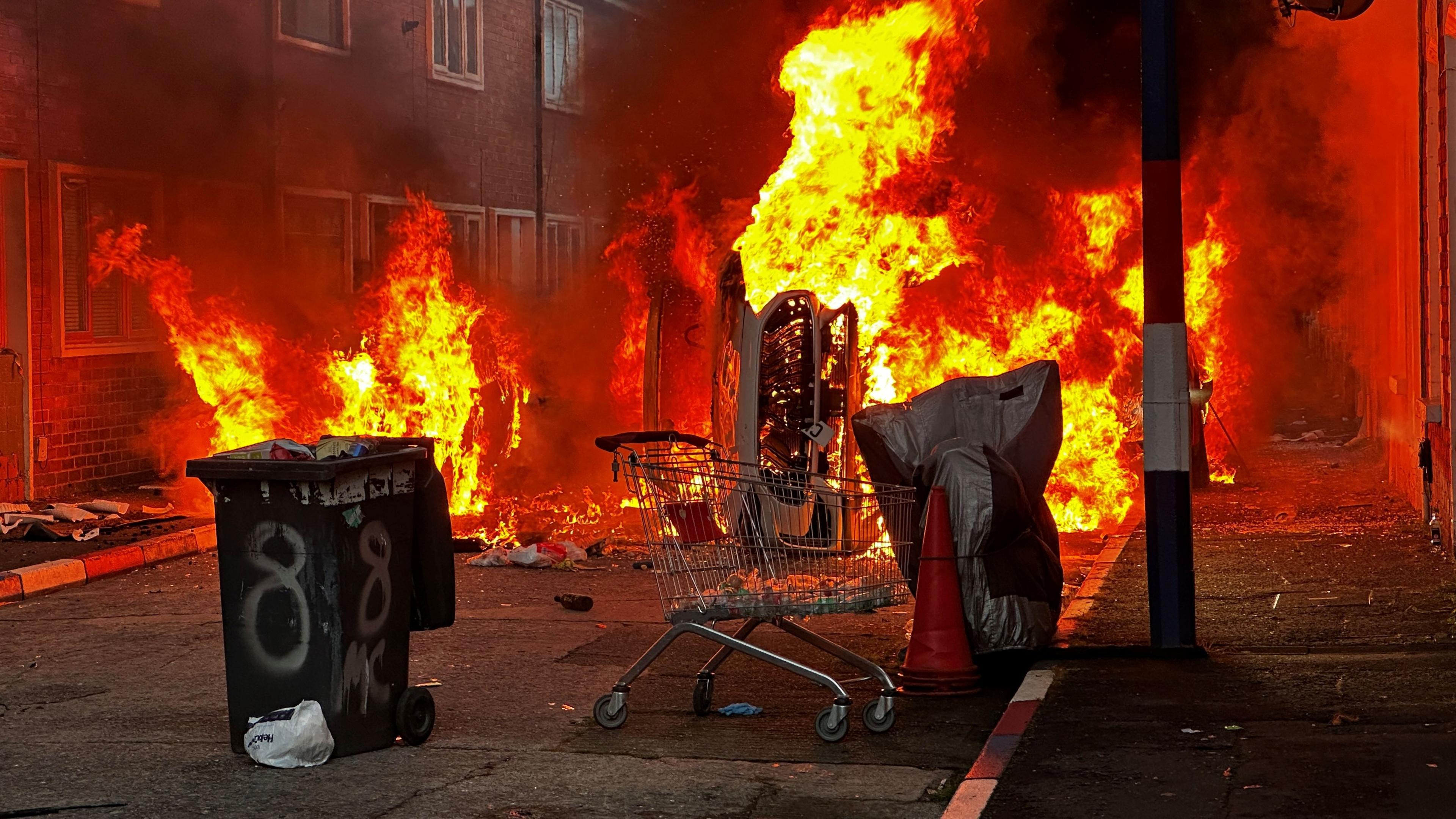
Public lists of HMOs across Northern Ireland were removed after riots in June that saw some of those properties, and migrant families housed in them, targeted for violence.
Lisburn and Castlereagh Council and Ards and North Down Borough Council have voted to publish details of HMOs in those council areas. A number of other councils are set to discuss their own lists in the coming days.
PSNI Supt Joanne Gibson said that police had warned councillors in Lisburn that publicising the data "may lead to targeted activity against occupants".
Michaela Rafferty, who works with the Anaka Women's Collective helping migrant women, said publishing the lists "definitely increases danger for migrants", adding that she would like to see the government stop the lists from being published.
"Everyone has a right to a private life," she said.
Referring to the violence in June, she said she feared this is "leading the way for that to happen again".
The violence in June began after a knife attack in Belfast, in which a man, Stephen Ogilvie, was lost an eye in the attack.
A Sudanese man, Hadi Alodid, has pleaded not guilty to attempted murder.
Several nights of violence followed, with homes and vehicles set on fire and some families targeted because of their race.
Some of the disorder was coordinated on social media, with addresses shared online leading the police to warn residents about their safety.
The disorder led Belfast City Council - which published a centralised list of all HMOs in Northern Ireland - to take the list offline.
Now, two councils - Lisburn and Castlereagh, and Ards and North Down - have voted to put their lists online.
What did the councils decide?
In Lisburn and Castlereagh, the council voted 19-18 in favour of publicising the list.
A number of unionists, including representatives from the DUP, UUP, and independents, argued in favour of publishing the data, citing the importance of transparency.
DUP Alderman Paul Porter told the council that "if members don't think that this is a major public issue to have this information. I'd love to know what planet you're living on".
"Are we really going to say from this council, that on behalf of its ratepayers, who asked us to speak for them, we're going to actually take what information they're allowed to receive?
"I think it's ludicrous."
UUP councillor for Lisburn, Nicholas Trimble, said it is important "to put yourself into the shoes of people who feel that they could be targeted" because of their race.
"So I have absolute sympathy for them and I think we have to be mindful of that when we come to a decision," he said.
"So in principle, yes, publish, if there's no risk and if there is a risk, then redact, because I don't think we want to be putting anyone's safety into question."
Alliance councillor Claire Kemp, however, said that they could not ignore the violence earlier this year when "HMO information was used to help identify properties that subsequently became targets".
They argued that removing public access to the register would make it more difficult to identify unlicensed properties.
In both councils, Sinn Féin, Alliance, and SDLP councillors opposed the decisions.

Beverly Simpson, who is an anti-racism campaigner, said she believes the publication of the lists could result in "someone losing their life".
Simpson said she does not see a reason for council to publicise the information.
"People of colour will be targeted," she said.
"Once addresses are release, it's a recipe for disaster."
What are other councils doing with their HMO lists?
A spokeperson for Belfast City Council said, earlier this month, councillors had decided not to reinstate public access to the online facility containing entries from the HMO register.
However, they said this will be reviewed annually.
A spokesperson for Derry City and Strabane District Council said a committee considered the issue of public access to the HMO register in November and "recommended that the register should remain unavailable online at this time, subject to annual review".
A spokesperson for Antrim and Newtownabbey Borough said councillors plan to discuss their HMO list, which is currently not publicised, on 30 November.
Meanwhile, Mid and East Antrim Borough Council plan to discuss their HMO list on 1 December.
Supt Gibson said the PSNI's concerns regrading the publication of HMO lists "is informed by the previous online sharing of register information, which may have contributed to activity directed at such properties during the disturbances in June 2026".
The Home Office and the Department for Communities were approached for comment.
The Housing Executive declined to comment.
What is a HMO?
In general, a HMO is a property occupied by at least three people who are not part of the same household and who share facilities such as a kitchen, bathroom or toilet. It must be their main residence.
A building made up of self-contained flats is not a HMO. Landlords have, however, unsuccessfully argued in court that rooms in HMOs were self-contained flats because they contained their own microwave.
The distinction matters because HMOs are subject to additional rules and regulations, and landlords may need a licence from the local authority to operate them.