
Want to bookmark your favourite articles and stories to read or reference later? Start your Independent Membership today.
Join todayAlready a member? Log in
Andy Burnham hailed his deal with the European Union (EU) as a “win-win” and said it would deliver a £17bn boost to the UK economy.
The prime minister is in Brussels and has signed agreements covering food and agriculture exports, emissions trading and a youth mobility scheme which could open the doors to around 100,000 young Europeans to temporarily work in the UK.
About the deal, the prime minister said during the press conference that it “is a good day for Britain, and this is a good day for Europe.
“The agreement that we’ve reached together is a win-win, and it is in tune with public opinion in the UK”, he said.
European Commission chief Ursula von der Leyen said the deal marks a “turning point” in post-Brexit relations between the UK and the bloc.
But tensions still remain, with a six-month deadline put on reaching an agreement over EU demands to cut tuition fees for students from member states studying at British universities.
The Independent’s editorial campaign Europe: The Way Back is for readers who want a clearer, more constructive conversation about Britain’s future with Europe.
It brings together reporting, analysis, comment, reader debate, newsletters, polls, podcasts and video to explore what closer relations with Europe could and should look like over the coming years.
Stay Out campaign chair calls deal a 'humiliating spectacle' for the PM
Oliver Lewis, chairman of the Stay Out campaign opposed to returning to the European Union, said: “This whole thing has been a humiliating spectacle for the prime minister.
“Burnham has been played like a fiddle by Brussels, which took one look at how badly he wants a deal and decided British taxpayers should foot the bill for cheaper fees for EU students before it will sign anything.
“This will only ever end one way, with more and more of our money handed over to Brussels until we are paying the £750 million a week it would cost to rejoin.
“The sooner the prime ,inister takes it on the chin and cuts his losses, the better.”
Shadow chancellor of the Duchy of Lancaster: 'Burnham is reopening divisions of the past'
Alex Burghart MP, deputy leader of the Conservative Party and shadow chancellor of the Duchy of Lancaster, has criticised the UK’s deal with the EU as “reopening divisions of the past”.
“Rather than fixing the big problems facing the country like the spiralling welfare bill and the need to fund our defence, Andy Burnham is reopening the divisions of the past.
“Because he is a bad negotiator, British taxpayers will be left paying into the EU, our energy prices will increase, our farmers will be forced to follow EU rules and we will see hundreds of thousands more migrants coming here just when Britain is seeing a lost generation of young people unable to find work. Labour haven’t ruled out asking British taxpayers to subsidise European students’ university fees, despite not being able to find the money to fix plan 2 student loans.”
Recap: Deal with the EU will add up to £17bn a year for the British economy
Andy Burnham has said his deal with the European Union will add up to £17 billion a year to the British economy as he paved the way for even closer ties to Brussels.
The prime minister said it was a “good day for Britain and a good day for Europe”, as he met EU chiefs in Brussels to announce a package covering food and agriculture exports, emissions trading, and a youth experience scheme which could open the doors for 100,000 young Europeans to temporarily work in the UK, with Britons able to do the same on the continent.
He said the next 12 months would be spent “brainstorming” ideas with the EU for the future relationship between the UK and the bloc.
Mr Burnham said: “Incremental steps… only take us so far.”
Best for Britain boss: 'One small step in our economic fortunes but one giant leap for young people's opportunities'
Naomi Smith, chief executive of Best for Britain, which campaigns for the UK to restore its EU membership, said:
“Today marks one small step in our economic fortunes but one giant leap for young people’s opportunities, and British businesses who for too long have had their horizons narrowed and wings clipped by needless Brexit red tape.
“Having drawn a line under a decade of drift and division, the Prime Minister must now build on the bold leadership he has shown so far, and take the essential and laudable step towards restoring our EU membership, as the majority of voters the length and breadth of Great Britain now demand.”
Burnham: EU deal not a 'fig leaf'
Andy Burnham said it was “a little harsh” to suggest that the deal with the EU was a “fig leaf”.
He pointed to worries about the impact of the EU’s Made In Europe scheme on the British car industry that he says the deal alleviates and collaboration on the food agreement.
“We are facing the undercutting of European and British industry from overseas exports, and we should face it together.
“And that is what the text talks about. So, our experts, European experts in the same room dealing with these challenges together. That is progress, I would say, not a fig leaf.”
FSB: New deal could end border headache for small businesses
The Federation of Small Businesses (FSB) national chair, Tina McKenzie, has said the new deal could end border headaches for firms.
“From British cheese and meat heading to Europe, to fresh fruit and vegetables coming into the UK, moving food across the UK and Europe should be about trading goods, not fighting through mountains of paperwork.
“The new UK-EU Sanitary and Phytosanitary (SPS) Agreement reached at the summit is a major step forward. The Government must now deliver the legislation needed to put it into practice so that small businesses can benefit from reductions in border checks, delays and costs. Fundamentally, reducing costs on small businesses will increase trade and economic growth
“Our figures show that change is needed. Almost two thirds (63 per cent) of small firms trading with the EU have faced significant barriers. Of those moving goods across the border, 64 per cent have struggled with customs paperwork, while one in five have faced problems with physical inspections.
“This can hold up entire shipments or leave businesses with stock they can no longer sell after inspection.
“Despite this, the EU remains a vital market for small businesses. More than 90 per cent of SME exporters sell to the EU and 87 per cent of SME importers buy from the region. Yet a third (34 per cent) expect to reduce or stop trading with the EU if current arrangements remain unchanged/
“However, this agreement must not replace one set of barriers with another. Small firms cannot afford to absorb costly changes to meet new regulations and the Government must give them clear and practical guidance before any new rules take effect.
“The summit's commitment to further discussions on economic security and resilience is also welcome, particularly the focus on keeping UK small firms connected to European supply chains.
“The test now is whether these agreements deliver real changes for small firms, not more paperwork.
“In the lead-up to the summit, FSB joined forces with SME united to ensure that small businesses across Europe were represented in negotiations. In representations to UK and EU leaders, FSB and SMEUnited called for an SME-first approach that lower trade costs, reduce regulatory barriers, ease business travel and improves co-operation on economic resilience.”
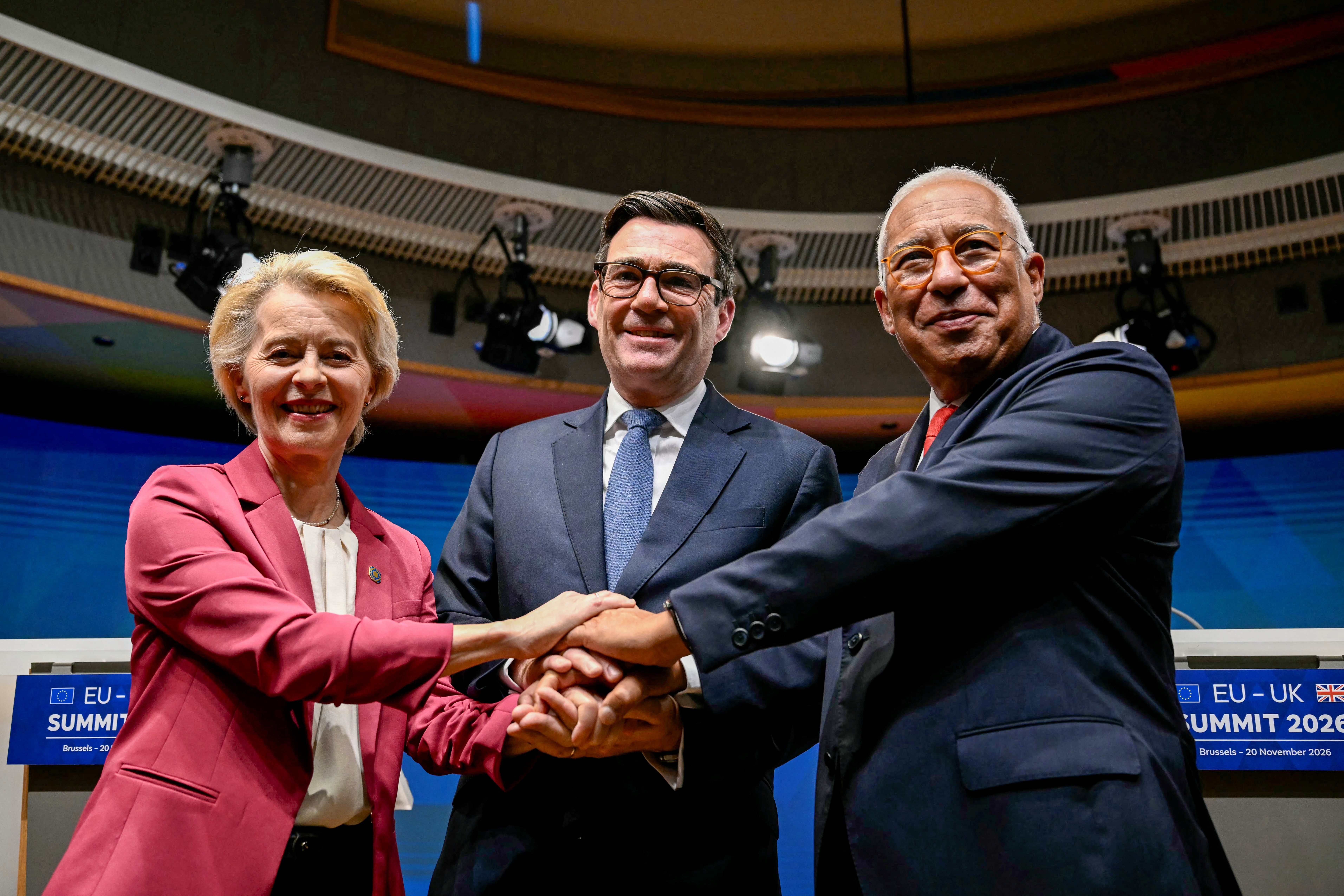
Pictured: Costa, von der Leyen and Burnham show on united front
Stormont minister supports UK-EU deal as a 'good deal for Northern Ireland'
Stormont agriculture minister Andrew Muir has said an agreement between the UK and EU in Brussels covering food and agriculture exports is a “good deal for Northern Ireland and will make a real positive difference for consumers, businesses and our farmers”.
He said: “I have worked hard to ensure Northern Ireland’s voice has been heard throughout the negotiations and, whilst this will not fix everything, it’s a massive step in the right direction.
“There will be huge benefits for all of us in Northern Ireland from reduced trade barriers and less checks on goods moving between GB to Northern Ireland.
“This will mean lower administrative hurdles and costs for businesses and government, as well as making it easier for retails to put produce on our shelves.
“There is still much work to be done to address the many consequences for Northern Ireland arising from Brexit, that is why I will continue to advocate for closer and strengthened ties with the EU.”