A bullet-peppered mural of the Haitian striker Emmanuel Sanon covers the facade of Port-au-Prince's main football ground. But more than two years have passed since any sports stars graced the pitch.
In 2024, as the surrounding city was almost entirely captured by heavily armed gangs, Sylvio Cator stadium – where football greats including Brazil's Ronaldo and Roberto Carlos once played – also fell under criminal control, its dilapidated red and blue stands used as an outpost by fighters working for a gang boss called Izo. Haiti's national team, the Grenadiers, found itself homeless and was forced to play its World Cup qualifying games abroad.
That changed last week, as Haitian police and troops from El Salvador reconquered the stadium. Nayib Bukele, El Salvador's authoritarian president, called the development a step towards delivering Haiti from a criminal insurrection that has displaced more than 1.5 million people and killed thousands.
"We now have the upper hand on the ground," claimedBukele, who has sent more than 2,000 soldiers to Haiti since mid-October.
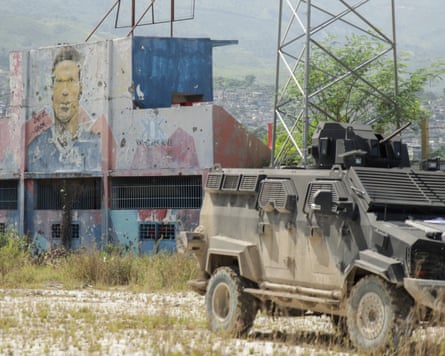
Outside the Sylvio Cator stadium, named after an acclaimed Haitian athlete who won a silver medal at the 1928 Olympics, there were joyous scenes as citizens celebrated a foreign politician they hope will prove an unlikely saviour.
"There's a wind of hope blowing through our country and, thanks to God, we will get through this. Long live Bukele!" said a 55-year-old decorator who asked to be named as Bòs Baton.
Stood by Sanon's battle-scarred fresco, Baton recalled being driven from an area called Poste-Marchand after criminals set his home ablaze during an armed uprising that started in February 2024. "Today, we are happy because there are places we couldn't go to before that are accessible – and it's thanks to Bukele's intervention that we can be here today," Baton said.
Identical sentiments have been voiced on the streets of El Salvador's capital, San Salvador, in recent years as a result of Bukele's controversial anti-gang crusade, which has freed millions from gang rule – albeit at a high price.
Since that crackdown began in early 2022, more than 90,000 Salvadorans have been jailed as part of a mass incarceration campaign that has slashed murder rates but also fuelled fears that El Salvador's democracy has died.
Bukele's domestic clampdown has made the millennial strongman a darling for rightwing politicians and voters across Latin America and the Caribbean, who hold his actions up as proof that, with an iron fist and a malleable approach to human rights, rampant criminality can be tamed.
Now, as Bukele seeks to extend his seven-year presidency in an election in February, he is hoping to burnish his gang-busting credentials overseas.
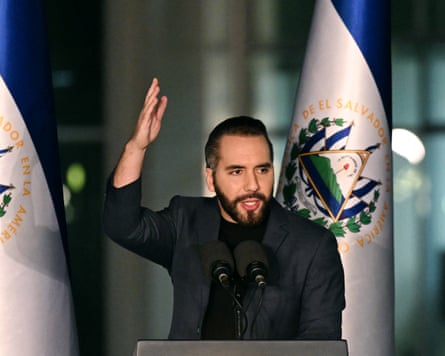
"It's an operation that projects force, that projects Bukele's image as the saviour … and positions El Salvador as a key reference in the region for [how] … to deal with gangs and security," said Tiziano Breda, a Latin America regional expert from the Armed Conflict Location and Event Data project.
The extent of Bukele's ambitions in Haiti is unclear. The operation's trigger was the 18 October abduction of four Salvadoran aviation technicians who worked for a UN-backed security force. On Monday, Bukele's vice-president, Félix Ulloa, announced Salvadoran troops would withdraw as soon as the four men were rescued, "because this is not an occupying force – we are not there to stay".
But Ulloa also said his government was responding altruistically "to a cry for help from the Haitian people and government", suggesting its mission could be extended.
Bukele has also hinted his plans go beyond short-lived ground operations to recover his citizens, or their remains. "We will triumph. God will give us victory," the politician vowed this week.
Many Haitians hope his combatants will stay and have been thrilled by cinematic social media clips posted by Bukele showing helicopter strikes on a gang compound and the mansion of a gangster nicknamed Taliban.
Banners and billboards around Port-au-Prince celebrate Bukele as a 21st-century liberator and feature slogans such as "The bandits won't get a wink of sleep!" and "We're tired! Give us Bukele!"
Standing outside the liberated football ground, bricklayer Venel Saindor recalled how criminals torched his home in Carrefour-Feuilles three years ago. "It's impossible to enter my neighbourhood because the thieves are still there. They shoot at us," the 56-year-old explained, lifting his shirt to reveal a bullet scar above his right nipple.
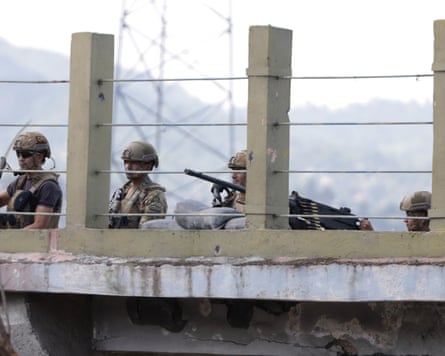
"We need Bukele to help us return to our homes," added Saindor, as a Salvadoran soldier with a belt-fed heavy machine gun kept watch from the stadium's terraces.
Monique Clesca, a writer and activist, echoed the bricklayer's enthusiasm. "Haitians are elated … [and] I feel elated also … It is a moment of hope," she said on Tuesday, as thousands of demonstrators poured on to the streets to champion Bukele, chanting: "Viv Bukele!" and "Bukele is not playing games!"
As a sea of protesters swept towards the prime minister's offices, people from all walks of life spoke of how armed groups had destroyed their lives and their collective hope that Bukele may provide a solution.
"I used to drive an old bus. The bandits burned it. They burned my house down too," said Wilné Persona, a 50-year-old driver, adding: "Bukele is the one we are waiting for … because we can no longer bear the situation."
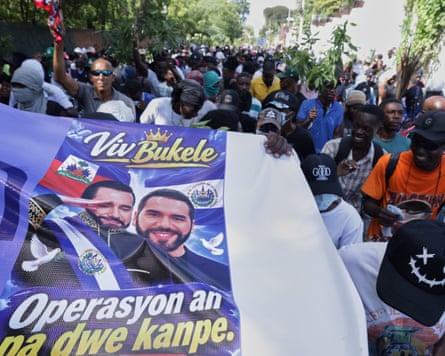
A food vendor called Claudy Mayas urged "Papa Bukele" to stand his ground. "Bukele, I bless you, your wife and your children," said Mayas, 51. "The Haitian people are with you, just as you are with us."
Clesca attributed the palpable excitement to the widespread perception that Bukele's "decisive" action had exposed the incompetence, inefficiency and indifference of Haitian and foreign leaders. "Basically, what Bukele has done is show that leadership is about resolving a problem for your population," she said, praising how the stadium and other areas were recaptured in less than a month.
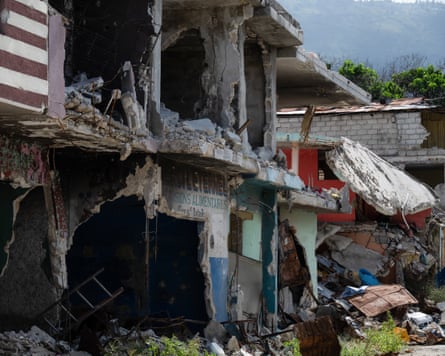
Amid the excitement there is also unease. Some fear Bukele's offensive could exacerbate an already volatile situation in and around Haiti's capital, much of which resembles a war zone. This week, there was heavy fighting between Salvadoran troops, police and gangs in Village of God, the shantytown that is Izo's main base. On Thursday, police said officers had killed at least 34 suspected criminals during an operation near the stadium.
Some suspect El Salvador's president, a social media whiz with 22 million followers on X and TikTok, could be exaggerating his troops' role in recent successes with help from a strike team of online propagandists and fans. "Nayib Bukele is gang kryptonite," one US enthusiast gushed this week, calling his intervention "a miracle".
Others fret over Bukele's ability to distinguish between gang members and civilians, given the indiscriminate nature of his mass detention campaign in El Salvador, where thousands of innocent people have been jailed without due process.
Clesca downplayed concerns over the toll Bukele's crackdown has taken on democracy and the rule of law in El Salvador, which now has the world's highest per capita incarceration rate. Haitian politics was so contaminated with organised crime, she argued, "it's almost like the mafia has taken over 10 Downing Street".
"If you're talking about [an] assault on democracy, Haiti is … almost a case study that is … even worse, more flagrant, than El Salvador," Clesca said.
The security situation was so dire that urgent action was needed. "Let's just be honest … in Haiti, we're being brutalised," Clesca said. "Girls are being taken as sexual slaves. They're being gang raped. So somewhere along the line, we have to say: 'Haiti helped [South American independence hero] Simón Bolívar [who received shelter and support from Haiti in the early 1800s] … and now, Bukele is helping us'."
At Tuesday's rally, protesters spoke of El Salvador's president in divine terms. "Today, we see Bukele as a saviour, as someone sent by God," said one man, before adding a word of caution that spoke to countless past interventions that have ended in frustration and failure.
"There is one thing I will say to President Bukele," he said. "He must not start with us and leave us halfway."