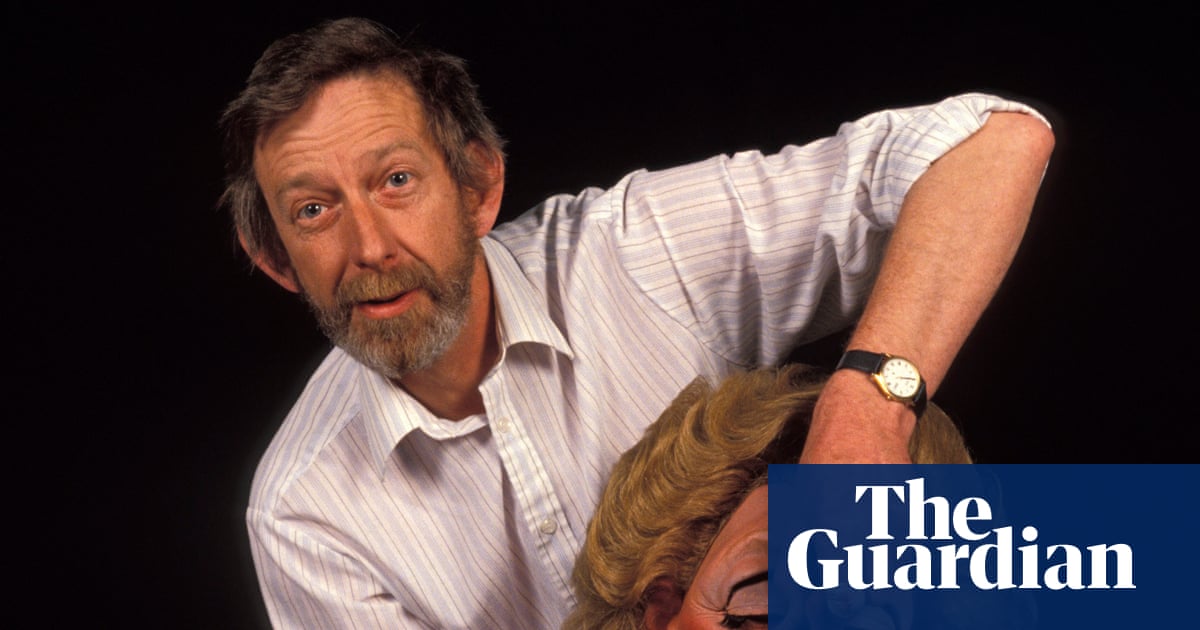
Peter Fluck, who has died aged 85, was, with his fellow artist Roger Law, half of the Fluck & Law partnership that revived satire on TV with Spitting Image, the ITV puppet sketch show lampooning celebrities, politicians and the royal family.
Two decades after the BBC's That Was the Week That Was spoofed the British establishment and, in particular, the last days of Harold Macmillan's Conservative government at the time of the John Profumo affair, Spitting Image, from 1984 to 1996, mined another period of Tory rule rich in distinctive characters, exaggerating elements of their personalities.
Margaret Thatcher was portrayed as domineering, aggressive and, as time went on, increasingly tyrannical, verging on madness; Norman Tebbit as a tough thug in a leather jacket; Geoffrey Howe as dull; Nigel Lawson as incompetent and a panicker; Cecil Parkinson as a playboy; and Douglas Hurd with a Mr Whippy hairstyle.
When John Major took over as prime minister from Thatcher, he was not only represented as colourless and dull, eating peas, but physically painted grey all over.
The leaders of opposition parties, Neil Kinnock and David Steel, were treated just as cruelly, while Ronald Reagan was seen as genial, elderly and dangerous, and big names of the time – from Mick Jagger and Ian Botham to Rupert Murdoch and Laurence Olivier – made the celebrity lampooning all-embracing.
Most controversial in the early days was the inclusion of the royal family, including a gin-soaked Queen Mother, and Queen Elizabeth II always wearing a tiara, even under her headscarf.
In creating each puppet, Fluck produced a drawing from photographs, making it a recognisable caricature, before the pair developed a clay head and sculpted the facial features.
"I'm quicker when it comes to putting a likeness down on paper, but Roger Law is faster at breaking down a likeness in clay than I am," said Fluck. "We kept turning the clay mould around on the board, switching it between us until we suddenly decided it was finished."
From this, the puppets' heads were cast in foam latex, with bodies mostly of foam. In front of the camera, facial features were operated by a system of wires, rods and cables devised by Fluck.
The pair met at the end of the 1950s as students at the Cambridge School of Art (now Anglia Ruskin University), where a part-time tutor was Paul Hogarth, an "artist-reporter" whose paintings and illustrations depicted events from the Spanish civil war, apartheid South Africa and other countries on his travels. He inspired in Fluck and Law an interest in political caricature.
After creating grotesque plasticine models of public figures, which were then photographed, for the Economist, the Sunday Times Magazine and others, they were approached by the graphic designer and branding expert Martin Lambie-Nairn in 1981 about bringing their characters to life on TV. Fluck and Law decided that would be best with puppets.
John Lloyd, after producing the BBC's live-action satirical sketch show Not the Nine O'Clock News, helped to pitch what was originally titled Spit N Image to broadcasters. LWT, Thames Television, the BBC and Channel 4 all turned it down before the ITV company Central Independent Television took it on.
With Lloyd as producer, Spitting Image was launched and, after a shaky start, it captured the public's imagination and won an International Emmy award two years running (1985 and 1986).
But it was an expensive programme to make and, by 1996, audiences had fallen from 15 to 6 million, so it was axed.
Returning to being a full-time artist and sculptor, Fluck showed no interest in being part of a Spitting Image revival for the joint ITV-BBC subscription channel BritBox in 2020, when Law returned to lead the creative team.
Born in Cambridge, to Ada (nee Hughes) and Herbert Fluck, a gardener at Magdalene College, Peter grew up birdwatching and drawing stuffed birds at the university's Museum of Zoology. Leaving Cambridgeshire high school for boys aged 16 with "four rather miserable O-levels", he started studying at Cambridge School of Art and reflected that Hogarth helped to guide him and Law "into the politicised 1960s", when they marched with CND and helped with its promotional material, designing pamphlets and making woodcuts.
The pair moved to London and became freelance illustrators, with Fluck supplementing his income by teaching at Hornsey (now part of Middlesex University) and Colchester schools of art.
They then worked together on 2D and 3D plasticine models. These were photographed for publications such as Private Eye, the New Statesman, glossy magazines and newspaper colour supplements, and even seen in Germany in Stern and Der Spiegel, and the US in Time and the New York Times.
In 1976, the year in which they formalised their partnership as Fluck & Law, working from a defunct temperance mission hall in Cambridge, they produced a Radio Times front cover of an "all-American family", including dog, engrossed watching television to promote programmes marking the American bicentennial.
Following the end of Spitting Image, Fluck moved to Cornwall and, living in a cliff-top house in a fishing village, worked and exhibited as an artist whose creations included mobiles, ceramics, interactive installations and sculptural pieces.
In 1963, Fluck married Anne-Cécile de Bruyne. She and their son and daughter survive him.