
Want to bookmark your favourite articles and stories to read or reference later? Start your Independent Membership today.
Join todayAlready a member? Log in
Schools have been urged to prepare for blackouts and overnight pupil stays in case of emergencies such as cyberattacks and extreme weather events.
Updated Department for Education (DfE) guidance published on Thursday says schools should consider the risks of a number of emergency events including “cyber incidents” and “conflicts and threats originating outside the setting”.
“Preparations should be proportionate to your setting’s risks and needs, including the possibility that people may need to remain on site unexpectedly,” the guidance reads.
The department also published nine “emergency action” cards alongside the guidance, which lay out what schools should do in different scenarios. In the case of a national power outage, the cards tell teachers to fill containers with drinking water, check they have food available, and ensure pupils have access to warmth and medication.
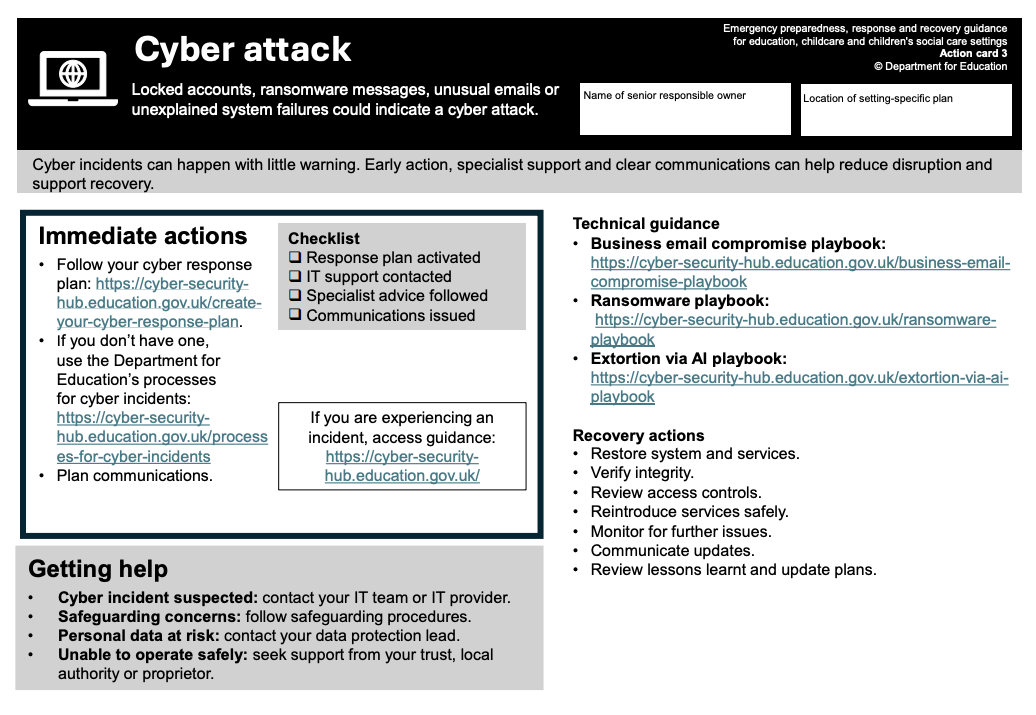
The government has also issued instructions for schools to follow in the case of physical threats, infectious disease, extreme weather, environmental hazards, cyber attacks, connectivity loss, building failure or collapse, and water shortages.
Schools are advised to stay open where it is “it is safe and reasonably practicable to do so” and urged to be ready to work alongside emergency services and local authorities in the event of emergencies.
The Association of School and College Leaders (ASCL) told the BBC that schools "already strive to remain open in emergency situations and only take the decision to close where there is no alternative option".
It comes after the government launched its ‘Be Ready’ campaign, urging Britons to stock up on tinned food and bottled water in case of potential disruption. In October, defence secretary Wes Streeting warned that households and businesses should prepare for “increasingly sophisticated cyber attacks” and potential disruption to essential supplies by stocking key supplies.
Mr Streeting previously announced that Britain must be ready for war in 1,000 days, as the nation’s adversaries could be ready to attack the UK in 2030.
Explaining the ‘Be Ready’ campaign, he said: “In the face of those threats, which are not hypothetical but real, and not somewhere else but increasingly here, we have to step up and take seriously our national resilience as well as our national defence.
“It’s really important that we ask households and businesses are they prepared?”.
But the Lords National Resilience Committee previously warned that Britain is “seriously underprepared” for emergencies and threats, including cyberattacks and extreme weather.
The peers said more needs to be done “at a greater pace” to prepare for the way modern risks can intensify one another, with limited stockpiles of food and medicine leaving the country “dangerously exposed” to disruption in global supply chains.