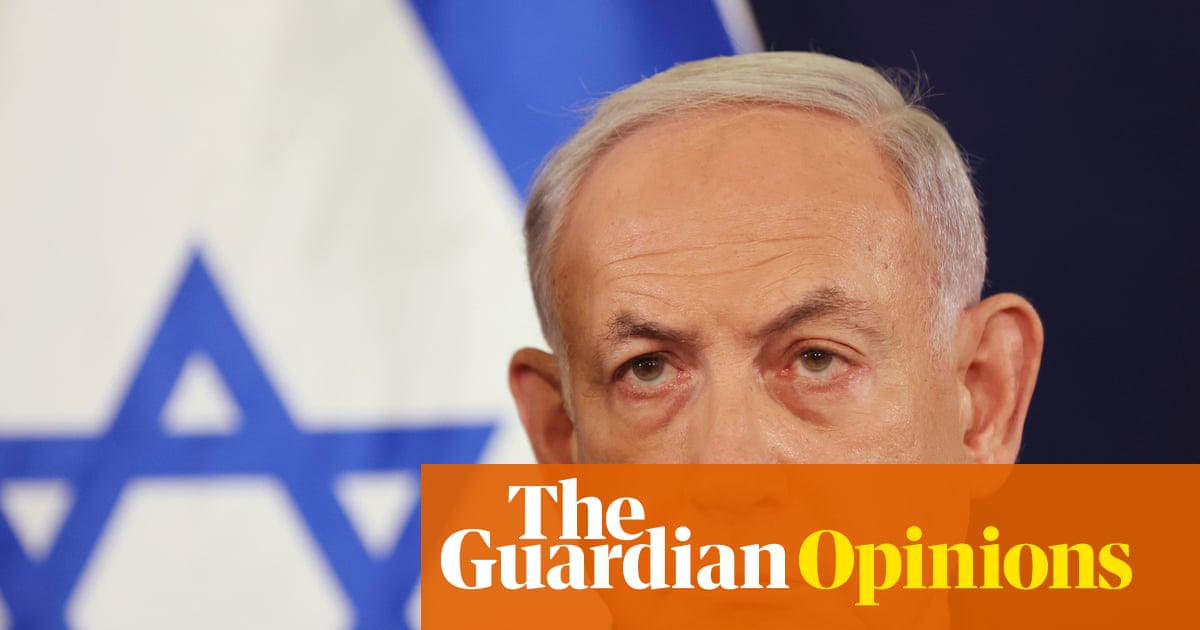
t's unsporting to kick a man when he's down. But let's make an exception for Benjamin Netanyahu. Ever since his far-right coalition government lost its mandate in last month's national elections, Israel's prime minister has been making an ugly spectacle of himself. His antics resemble those of a condemned man, desperately scrabbling to escape the gallows. This might not matter so much if, as has been widely assumed (and hoped), Netanyahu cannot ultimately avoid the drop. Yet his final downfall remains far from certain.
As protracted, complex talks proceed over who will form Israel's next administration – certain to be some variety of multiparty coalition – Netanyahu, forced for now into a nominal caretaker role, is going to extraordinary lengths to cling to power, using every dirty trick in his well-thumbed handbook while calling for a "government of national unity" (excluding Arab parties). And the perception he has been hung out to dry by a similarly electorally humbled Donald Trump, his biggest ally, may also prove over-optimistic. Besieged Palestinians in the West Bank and in hungry, flooded Gaza, and the bombed and battered people of Iran, have good reason to be fearful.
Netanyahu's bad-loser machinations ape those of Trump after Joe Biden expelled him from the US presidency in 2020. They include wild and unsubstantiated claims of electoral fraud involving Palestinian-led parties, whose unexpected haul of 19 parliamentary seats on a huge turnout has given them a potentially decisive say over who may form and lead the next government. He's also parroting familiar, unfounded, non-specific allegations of foreign meddling. Investigators have found no evidence to justify these slurs – but, like Trump and Maga, Netanyahu and his extremist populist-nationalist allies and media backers keep repeating the lies anyway.
After sidelining the Arab-Israeli parties, Netanyahu's "secondary goal is to incite the masses who heed his words to march on the Knesset next Tuesday [17 November] – the day of the speaker's replacement – and prevent the plenum from convening. Or also to signal to outgoing coalition MKs to blow up the session," warned Haaretz columnist, Yossi Verter. Such predictions are rightly ringing alarm bells over the future governance of a country that claims to be the Middle East's only democracy. In dismaying prospect is Israel's very own 6 January 2021, the notorious date of Trump's failed Capitol Hill insurrection.
Netanyahu's racism, never wholly concealed, has grown overt, blatant and repulsive. Any coalition that included, or was supported by Arabs, would be a "government of national suicide … with those who seek to destroy the state of Israel and establish a Palestinian state on its ruins," he said in a recorded statement. The unmistakable implication was that all Arab-Israelis – about 21% of Israel's total population – should be regarded as actual or potential Hamas-sympathising terrorists. "The fire and flames in the streets of Paris and Brussels will pale in comparison to the fire we will see in Jerusalem, Tel Aviv and Haifa. Israel simply will not survive," he said.
Despite his calamitous, unaccounted-for failure to prevent the 2023 Hamas attacks, the prime minister continues to claim only he, and he alone, can keep Israel safe. After witnessing another panicky, almost hysterical Netanyahu speech at last week's Knesset swearing-in ceremony, Gadi Eisenkot, leader of the main opposition "change" group who has been given first chance to form a government, condemned his behaviour as shameful and hateful. "I became even more convinced that he is unfit to continue in office for even one more minute," Eisenkot said. "We must act urgently to establish a national emergency government. The continuation of his rule divides Israel and endangers its security."
Worries about more war to come are supported by reports that Netanyahu has not given up on his hopes of resuming attacks on Iran, thereby creating a new security crisis, boosting his own position and postponing a change of government. Eisenkot has pre-emptively warned him against such a move in a formal letter, urging him to "demonstrate national responsibility [and] exercise caution and restraint in making dangerous moves … Do not violate the people's trust in government institutions and the decision-making process". Eyal Zamir, Israel Defense Forces chief of staff, and other generals are said to have told US counterparts before the election that they believed Netanyahu was planning to draw Washington into a third military confrontation with Tehran in two years.
Swingeing Republican defeats in the US midterm elections, attributed in part to the unpopular and costly Iran war, appear to have jolted Trump into dropping any idea of renewed conflict – for now. He has also faced a backlash from within his own party, including from the vice-president, JD Vance, who specifically blamed the Iran war, and Trump's unquestioning support for Netanyahu and Israel, for the poor results. Polls show that over time, moderate Republican and independent US voters are growing less supportive of Israel, while some younger Republicans also acknowledge the Gaza genocide and unrelieved Palestinian suffering there and in the West Bank.
Yet Trump remains highly unpredictable. He is already shrugging off the negative midterms verdict on his agenda, and is plainly determined to declare victory over Iran, one way or another. Last week Vance was summarily dismissed from his Iran negotiating role, with Trump insisting talks with Tehran were at an end. The US continues to exert military and increasing economic pressure on Iran, notably through an air, land and sea blockade. And the global oil price crisis persists. Sooner or later, the Tehran regime, fearing collapse or internal revolt, may feel forced to retaliate. If that happens, it will be Netanyahu's opportunity. He may even artificially hasten a new confrontation, once again sucking in hapless Trump.
Take a step back from all this and consider the bottom line. The fact that Netanyahu remains in power as of now, and is still in with a chance of continuing as prime minister if opposition coalition negotiations stumble, self-destruct or are sabotaged, is extraordinary, unacceptable – and deeply shocking. Over many years, he has done incredible damage to Israel's international reputation, not least in the US, and by his unending, grossly disproportionate war-making in Lebanon, Syria, Iraq, Yemen and Iran. He faces arrest by the international criminal court for alleged war crimes. At home, he is on trial for corruption; he is overseeing unprecedented terrorist settler violence aimed at illegally annexing the West Bank; and he stands accused of undermining Israel's democracy through his judicial overhaul, attempts to muzzle broadcast media, cynical election manipulation and brazen lies.
Netanyahu is a disgrace to Israel and democratic governance everywhere. It's time to say "enough". Even though his defenestration will not, by itself, resolve the bigger issues, it would greatly help. He must be stopped. And this rare, post-election opportunity to stop him once and for all – to unequivocally, permanently eject him from office and from power – must not be missed, messed up or fumbled. "Bibi" must answer for his criminal conduct and misdemeanours, personal and political. If, as has happened before, he is allowed to wriggle free, not only Israel and Palestine but the entire world will pay a terrible price.
-
Simon Tisdall is a Guardian foreign affairs commentator